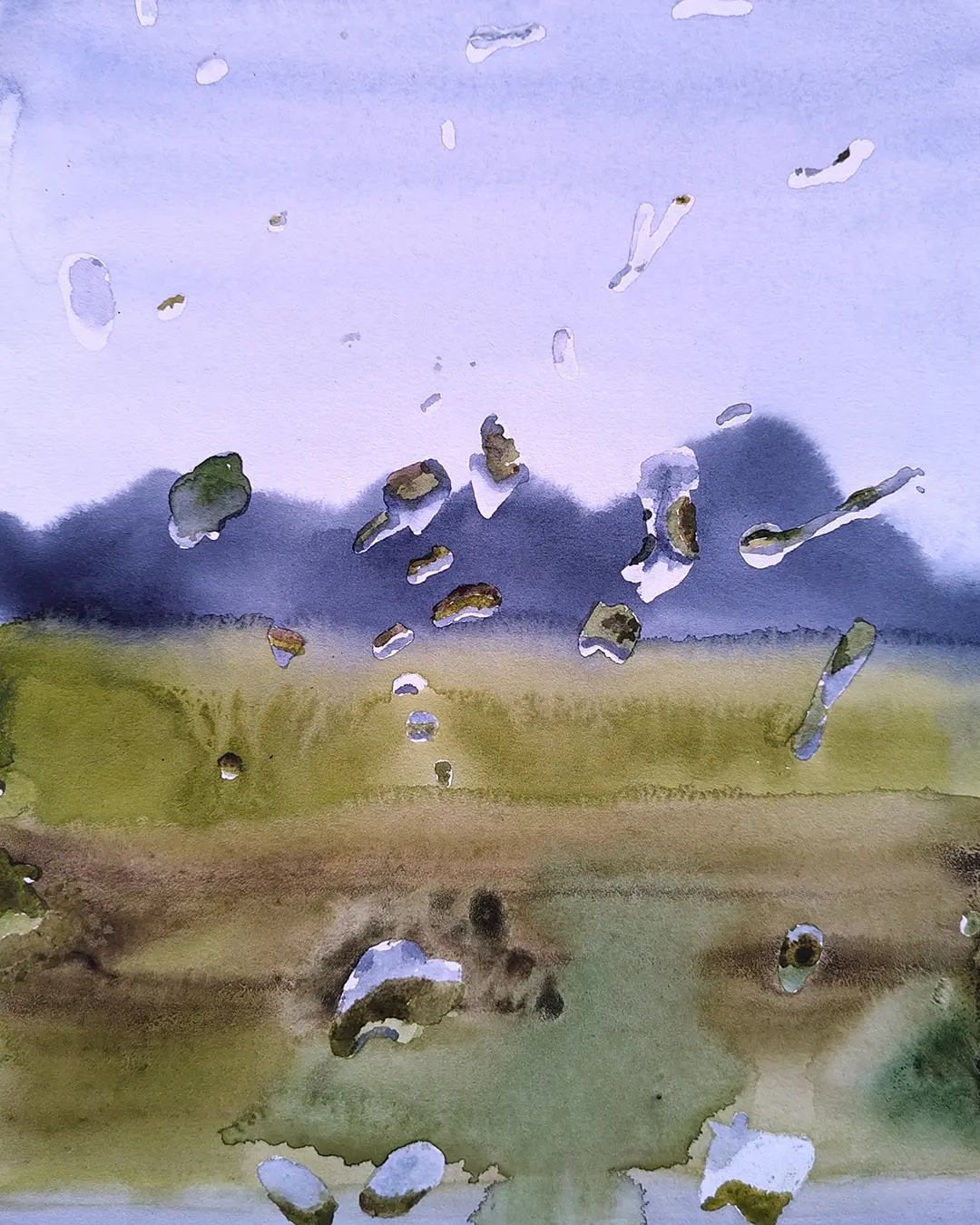
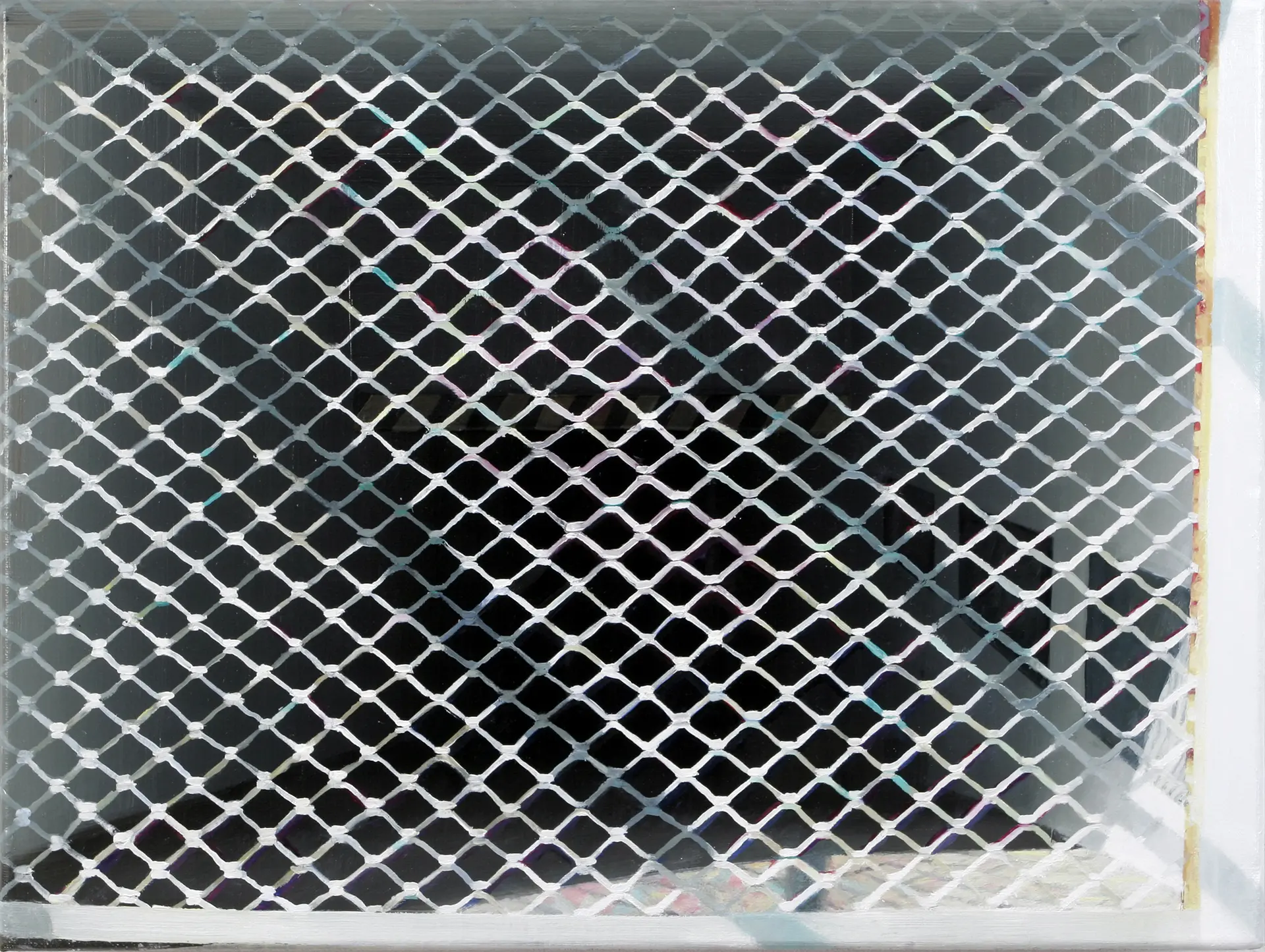
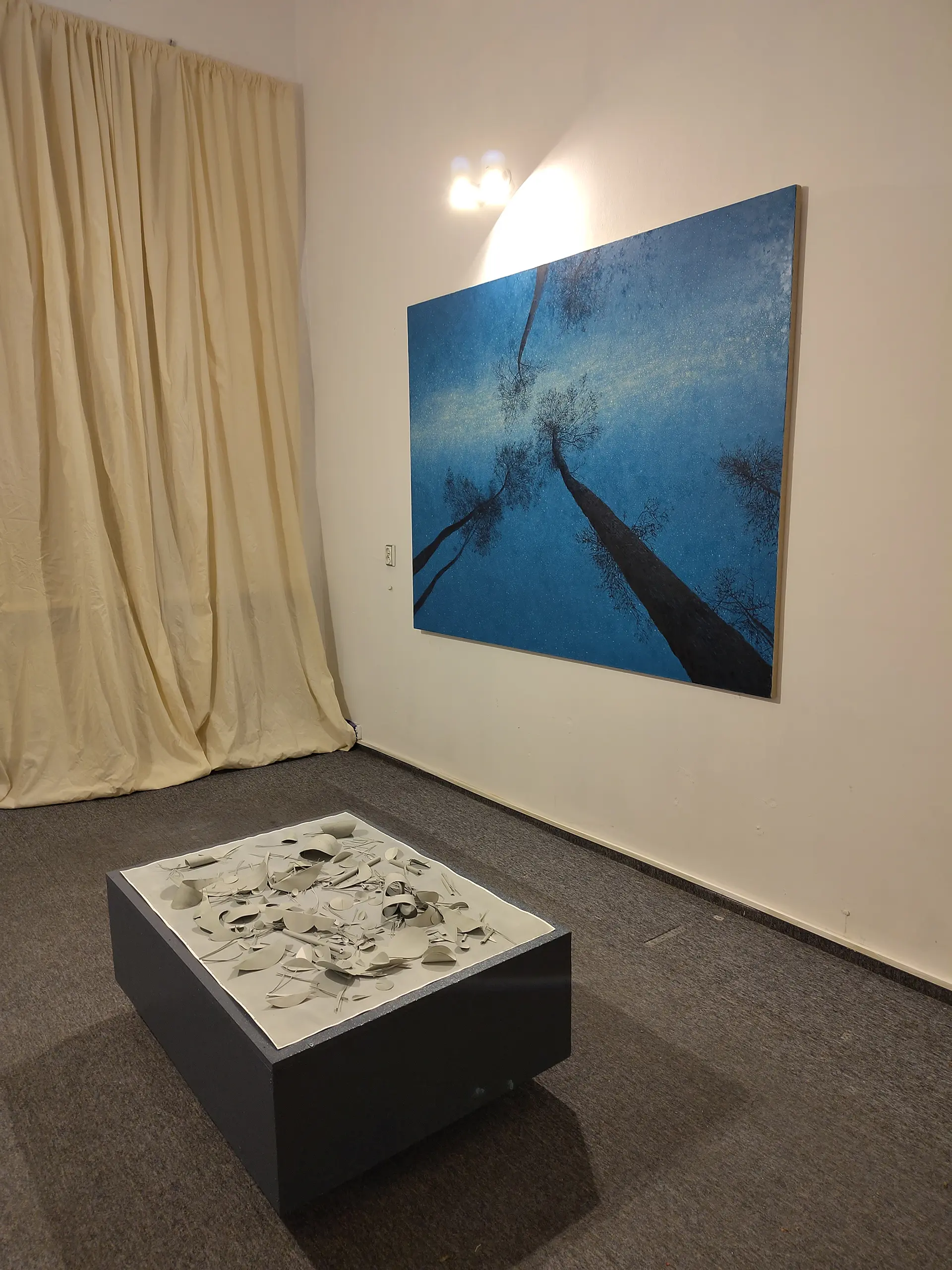
Nature is My Homeland, a catalogue summarizing the project of the same title
Edited by: A. Jankowska-Marzec
Published by the Jan Matejko Academy of Fine Arts in Krakow, 2021
Agnieszka Jankowska-Marzec: The title of the Vistula is burning exhibition, prepared as part of the Nature is My Homeland project has – and I think you will agree with me on this – an almost apocalyptic overtone. What is it supposed to suggest?
Magdalena Lazar: The title was supposed to have a local dimension – this beautiful catastrophe is not something that happens in a land far away, it is going on next door. The burning water is a clash of two elements, a kind of new birth. Water burns thanks to the constantly rising temperature of the surrounding environment. In scientific language, combustion means oxidation that emits heat and light. This light can be noticed, if we use some very sensitive devices. Oxygen is activated all the time and organic compounds are burned regularly. It is a slow process – if it weren’t, all the water on Earth would have burned by now. Many of the works that can be seen at this exhibition are created after such a close look at atmospheric phenomena. Vistula is burning was also Kora Jackowska’s cry in her song Narodziny Zbigniewa.
It seems that environmental issues have been a subject of many debates in the so‑called art world. Don’t you get the impression that as a subject, it is overly exploited by artists?
M.L. We are happy about this, because it allows for a certain re‑evaluation and change of our discourse – from overwhelming and apocalyptic visions, we move on to what happens next, since only less destructive images can save us. Lawrence Buell said that the environmental crisis is primarily a crisis of imagination. Harmful actions of people result, among others, from destructive views on the environment. Mitigating the future paralysis requires a reflection on the strategy for the survival of the individual, of microenvironments and of society as a whole. Thinking about the ecological themes appearing in my work, I noticed a change. In 2011, in my Atoms animations, I presented some dystopian visions – in a picture resembling urban CCTV camera feed, I showed the Vistula River drying up, orogenic movements taking the former Forum Hotel above the current ground level at an angle and the destroyed Piłsudski Mound. In the Laboratory of living sentiments in 2019, I wondered if love could contribute to the invention of a chemical mixture that would stop overproduction as a side effect. This visual eco‑poetic story might sound absurd, but it has its roots in a true love story told to me by my friend, who’s a neurobiologist. In spite of the fact that the ecological catastrophe keeps us awake at night, we are very slowly beginning to see the bright side of what comes after the chaos. At the same time, the ecological crisis is present in our consciousness to such a great extent and became such an inseparable experience that it provoked an extraordinary reaction of our imagination. There is a style of narration that intensely penetrates the language in order to identify cultural patterns and metaphors for what is amazing, non‑discursive, and yet real.
Katarzyna Skrobiszewska: The first ecological turn in art came in the 1970s. In the meantime, the situation has not improved. Can we consider that creating exhibitions is ecology in action? Some claim that even though scientific knowledge about climate threats is gathered and disseminated widely, people seem to be unaffected by the seemingly distant consequences and unwilling to take action. I suppose that artists still have a role to play here. A work of art is an opportunity to experience an emotional, mental and physical state that can help them understand the scattered and certainly uncomfortable data.
M.L.: According to T. Morton, we live in a time after the end of the world, in which the future came too quickly and became the past. Our weakness and hypocrisy result in an aesthetic sense of asymmetry between the infinite power of cognition and the unlimited existence of beings. They reveal their inner phenomena, which are difficult to understand, sticky and hyperobjective. One of the most pressing issues is access to water. There’s less and less of fresh water on our Blue Dot, and we manage it in a peculiar manner. Recently, we have been learning how detrimental it is for rivers for us to extract sand required for concrete production. Climate change is causing worrying trends.
What were your criteria as curators, when it came to inviting artists to your project?
K.S.: When I invited Magda to work with me as a curator and artist, she just returned from a week‑long lunar mission at the Analog Astronaut Training Center, with a handful of lunar dust. I thought it was a good counterbalance to the Nature is My Homeland project. We are not going to move to the moon or to Mars – these are techno‑dreams. The nearest habitable planets are hundreds of millions of days away, and that’s far too long for us to ever be able to get there. I decided that it would be good to look at our earthly problems from this point of view. The next invited artists were suggested by Magda – Johannes Vogl and Michalina Bigaj with their Horizon a symbolic horizon line drawn with red neon. In her work, Michalina Bigaj explores the interaction between culture and nature, Johannes Vogl creates self‑sufficient designs on the borderline of functionality, which comment on the flaws of today’s world in a light‑hearted and humorous manner. A cosmic perspective, a burning urban horizon and an absurd poetry of everyday life – these three themes became the starting point of our exhibition.
M.L.: Ten years ago I was completely hypnotised in the corridor of the UdK in Berlin, where I studied for a semester as an exchange student. I was stopped dead in my tracks by Johannes Vogl’s Swing. This is a very strong and simple video showing a burning tire swing. I found it to be a perfect metaphor for the highest point of impertinence, which we reached in our relationship with nature. Johannes’ works are the result of astute observations of the surrounding reality, with a bit of that trickster element to them. His rainwater installation perfectly matches our conversations about the old and new weather, but also the space we have for the exhibition. I share a studio with Michalina Bigaj. We’ve known each other for a few years. In her practice, Michalina often asks how an artificial space of contact with nature highlights the illusion of human control over the forces of nature. Her work Horizon is a clear symbol that offers numerous references. If we look at it from a human perspective, it looks like a horizon at sunset. From the bird’s eye view it could be a burning river. We did not know the Serbian art scene. We are positively surprised by its diversity and dynamics. Following atmospheric phenomena and careful observation, we came across Tijana Petrović’s poetic and analytical film installation.
K.S.: The idea behind the exhibition was the participation of artists from the three partner countries, but after my visit to Belgrade we decided to broaden the Serbian representation. We found it difficult to choose from among many interesting artists discovered through our own research, the local art department, or active independent galleries. Luka Cvetković is a co‑founder of the artistic‑curatorial collective Institut Za Aplauz, which studies the relationship between (re)presentation and reception of art in public space. In an ironic performance by Luka, during the opening of the exhibition, firemen will serve water. The piece is devoted to the lack of proper solutions to pressing ecological, social and political problems. In his drawings, Davor Gromilović creates both extremely complex and densely populated compositions reminiscent of Pieter Bruegel’s paintings, as well as intimate scenes which take a closer look at the creatures he comes up with. In one of the interviews, he confessed: “I can’t remember where I found the idea for all the parts of this drawing. I definitely mixed up my childhood memories from the time I spent in the countryside. This period was particularly filled with good memories, which I can draw upon to create works of art.”
What do you expect from the artists taking part in the exhibition that you curated? How do you intend to develop the narrative of the exhibition? Base it on the opposites, or the complementary nature of the presented works?
M.L.: The exhibition was created very organically. At the beginning, we had a vague feeling about what it was supposed to be, and we selected artists mostly on the basis of the works they already created. I have the impression that the very place where this is going to happen is some sort of spectre of the past with the split sunlight – that beautiful golden mosaic by Krystyna Strachocka‑Zgud, which enters into a perfect dialogue with Tijana Petrović’s work The sun is lighter on the horizon. Kasia Skrobiszewska, in turn, was inspired by the suspended ceiling, a characteristic utilitarian element of interior design. Her work refers to the culture of fake news, disinformation and disbelief in climate change. Are we going to wake up when the ceiling starts falling on our heads?
K.S.: Yes, the space of the Cracovia Hotel was inspiring. A sort of site‑specific installation will be a fabric created by the invited artists, which will cover Cities – a mosaic by Husarscy in the former Orbis office, presenting possible travel destination in the former window to the world for the people locked behind the Iron Curtain. The crumbling maps presented by Serbian artists Emilija Radojičić and Mario Kolarić evoke questions about the feeling of being lost and our attempts to find our place in a confusing world. The narrative of the exhibition is set up in a way that makes the works complement each other. Zuzanna Banasińska studied a photo album found in Belarus, featuring photographs from service in the Soviet army in Crimea, discovering the history of the first messages sent into space. From the perspective of a disturbed temporal and spatial scale, she reflects on humanity controlling nature, the mechanisms of appropriation of territories and information pollution. Magda Lazar talks about closing the map – there are no more lands belonging to nobody on Earth, and we are witnessing the process of the division of the Moon. However, we do not want to solely focus on catastrophic visions, we are looking for the contemporary Ark (Gudrich) as an immaterial, spiritual space that is able to save life on Earth. We share the hope of solving our problems with young people from the past sending a message to their friends from the future (Banasińska). We look closely and thanks to this we know that the sun is brighter above the horizon (Petrović) and our perception is plastic.
At the end of our interview, I’d like to ask one more question, which might be a little naive. Do you believe that such exhibitions can raise the ecological awareness of the society? Perhaps their visually attractive form lets them have more impact than serious debates or professional literature?
M.L.: The observations of artists are often very close to the reflections of scientists; however, we tend to use a different language and discourse. The visual nature and ability to create situations that the viewers get into enables a different, empathic and sensual perception of the same insights that would be normally presented as figures. However, I am aware that the recipients of art are mostly people who are already aware of the general dangers and are environmentally active as far as possible.
K.S.: Our exhibition features works that can also be treated as an invitation to contemplate – watch a sunset and falling rain drops, look at the horizon, observe plants or body movement expressions. The unmediated contact with nature – something that modern humans sorely lack, as specialists warn us – helps build a bond with it and develops ecological sensitivity. Simple actions, such as those mentioned above, can be taken by those of us who find it difficult to get closer to nature due to various reasons, be it lack of time or other issues. Recently I read that for a social change to take place we do not need to convince 100% of the society, but only 3.5% – and it is said that we are close to this figure when it comes to climate change. In this situation, every voice counts. Even if our exhibition is noticed mostly by the artistic community, changing individual habits is not easy and immediate. It is also not easy to put pressure on decision‑makers – you need knowledge, courage and skills. The burning water and rebirth, mentioned in the exhibition title, will require effort, and the new world will certainly be born out of pain. That is why the metaphor of Noah’s Ark, invoked by Lea Gudrich, seems particularly important in this context. Lea, who spent her childhood in the countryside, decided to make children, holding animals in their arms and looking reproachfully at the viewer, the focus of her paintings. It is exactly the children, who will suffer the most from the consequences of the future catastrophe, whom the artist would invite to an ark, along with the living treasures of the natural world. In our exhibition, we also show portraits of children – half‑animal boy and girl. Their presence and gaze confront us with the urgent need to build structures that will be a space of collective consciousness, a space of law and solidarity extended also to the non‑human. Perhaps it is from animals that we will learn kindness anew – after Frans de Waal, who draws our attention to the fact that the capacity for compassion, the ability to cooperate and sacrifice are qualities that are not only characteristic of us humans.
Thank you for the interview.
The Vistula Is Burning, former Cracovia hotel, gallery of the National Museum in Krakow,
curators: Magdalena Lazar, Katarzyna Skrobiszewska, 2020